
Victorian Government Air Conditioning Rebate: DIY vs Accredited Provider
Major Benefits
Probably you're comparing quotes for a new reverse-cycle system; the DIY instinct makes sense: choose a unit, book an installer and claim the rebate- done. But the air conditioner rebate in Victoria isn't a form you fill in after the fact; it's a discount built into the sale price by an accredited provider, funded by tradable energy efficiency certificates. Skip that step and you're not just adding paperwork; you're potentially missing the discount altogether.
This quick guide breaks down what you actually control in the process, what you don't and where the real risk sits if you try to manage it entirely on your own.
Quick answer: Under the Victorian government air conditioning rebate, only an accredited VEU provider can apply the discount, but you're not locked out of choosing your own path. You can choose your own qualified installer as long as they partner with an accredited provider, and that arrangement must be in place before any work starts. Buying a system and trying to sort the discount out afterwards is possible in limited cases, but it's the riskiest way to do it.
Table of Contents
- What Does "DIY" Actually Mean Here?
- How the Rebate Actually Works
- DIY vs Accredited Provider: What's the Real Difference?
- The Biggest DIY Risk: Buying the Wrong System
- What About a Split System Rebate in Victoria?
- Can You Claim the Rebate After Installing the Air Conditioner?
- Is DIY Actually Cheaper?
- 7 Things to Check Before Accepting a Rebate
- Red Flags to Watch For
- So, Should You DIY Your Victorian Energy Rebate?
- Thinking About An Air Conditioner Upgrade?
- Frequently Asked Questions
People searching this topic usually mean one of three different things:
- Full DIY: buy a system, get it installed, try to claim the rebate afterwards.
- Choose your own installer: you pick the tradie, but they work with an accredited provider to process the discount.
- Compare providers yourself: you get quotes from several accredited providers and pick the best one, but the accredited-provider structure stays intact.
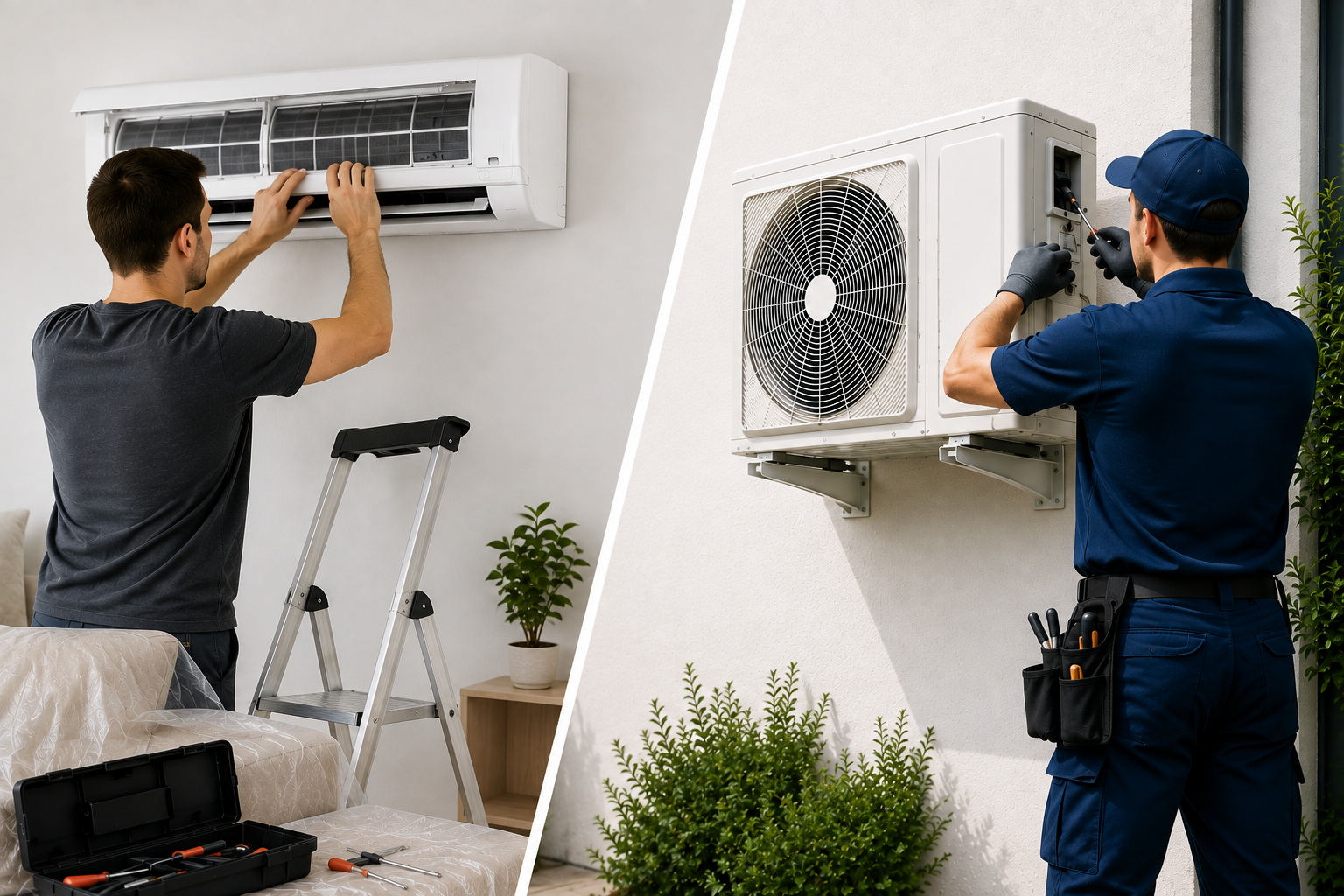
Options 2 and 3 are both completely fine and common. Option 1 is where people run into trouble, because the discount can't be applied after the fact by just anyone; it has to run through an accredited provider's paperwork, and ideally before installation.
The Victorian government air conditioning rebate sits inside the Victorian Energy Upgrades (VEU) program. Accredited providers install eligible high-efficiency reverse cycle systems (or arrange for a partnered installer to do it), generate energy efficiency certificates from the upgrade and sell those certificates to energy retailers. That revenue is what funds the discount on your invoice.
The practical flow looks like this: Check eligibility → choose an approved system → arrange it through an accredited provider → discount applied to the quote → installation → paperwork completed.
Accredited providers are the only organisations permitted to apply the discount. They can install the system themselves, or you can bring your own installer, provided that installer is partnered with an accredited provider and the arrangement is confirmed before work begins.
Is an accredited provider mandatory? Yes, for applying the discount itself. No, in the sense that you're free to pick your own installer, get your own quotes and stay in control of the decision. You just can't cut the accredited provider out of the transaction entirely and still get the rebate.
Not every reverse-cycle air conditioner qualifies, and "energy efficient" isn't the same as "VEU-eligible." To qualify, a system must:
- be listed on the Essential Services Commission's approved product register
- provide both heating and cooling (reverse-cycle)
- come with a minimum 5-year warranty for household installs
- replace an existing system that is more than 2 years old (if you're replacing rather than installing new)
There's no minimum system size requirement for a reverse-cycle upgrade, so even a single split system can qualify, but the specific model still has to be on the approved list. Buying based on price or brand alone without checking the model against the register can put your discount at risk.
A split system rebate in Victoria applies to non-ducted reverse-cycle air conditioners, and current discounts range from around $630 up to $1,610 for a household replacing a room gas heater with an eligible 3–9kW split system, with indicative annual bill savings of up to $460. Ducted upgrades attract larger discounts: up to $5,530 for a 22.4kW system replacing a ducted gas heater, with savings up to $1,140 a year.
The exact figure depends on what you're replacing and the size of the new system, which is exactly why a generic "$X rebate" claim anywhere online should be treated with caution. Get a quote for your specific situation rather than anchoring on a headline number.
This is the question that trips up most DIY attempts. Retrospective rebates are technically possible, but they come with real constraints:
- The claim must be processed by an accredited provider within 6 months of the end of the calendar year in which the installation happened. For example, a system installed in 2025 needs its retrospective rebate submitted by 30 June 2026.
- You'll typically need to provide the original invoice, any compliance certificates, evidence of the old system being decommissioned and geo-tagged photos of the site before, during and after installation.
- Not every accredited provider will take on a retrospective claim, since it's more work for them with no guarantee of approval.
In short: it's a safety net, not a strategy. Arranging the accredited-provider relationship before installation is the only way to be confident the discount will apply.
Once you account for the real workload (checking the approved product register, vetting an installer, confirming warranty terms, gathering documentation and accepting the risk of a retrospective claim falling through), "doing it yourself" often just shifts cost and risk onto you rather than removing it. A quote that already includes the discount is usually more predictable than a cheaper unit plus an uncertain rebate claim after the fact.
- Is the specific model on the ESC's approved product register?
- Is the provider currently accredited and active in your region?
- Is the discount already reflected in the quoted price?
- Who is doing the installation: the provider or a partner?
- Is the existing system old enough to qualify for replacement (over 2 years)?
- What documentation will you need to keep, just in case?
- What's the final, all-in price after the discount?
- "Every air conditioner qualifies." It doesn't. Check the register.
- "Install now, we'll sort the rebate later." Retrospective claims are time-limited and not guaranteed.
- "The rebate amount is the same everywhere." It depends on system size and what's being replaced.
- "We're accredited." Verify it yourself against the government's published provider list rather than taking it on faith.
If "DIY" means researching your options, comparing accredited providers and choosing your own installer, go for it. That's exactly how the program is designed to work, and you lose nothing by staying hands-on.
If "DIY" means buying a system and installing it before anyone accredited is involved, you're taking on real risk for a discount that may not come through. The Victorian energy rebate system rewards getting the accredited-provider relationship sorted first, not necessarily using the biggest or first company you find.
Before you buy a system or lock in an installer, it's worth checking whether your chosen model and upgrade actually qualify, and understanding how the discount gets applied before, not after, installation. EcoOrigin is a VEU-accredited provider operating across most of Victoria and can help you check eligibility and understand your options either way.
[Check Your Air Conditioner Rebate Eligibility]
1) Can I apply for the Victorian government air conditioning rebate myself?
Not entirely. The discount has to be applied by an accredited provider. You can, however, choose your own installer as long as they partner with one.
2) Can I choose my own air conditioner installer under VEU?
Yes, provided your installer works with an accredited provider and this is arranged before installation.
3) Does every split system qualify for a rebate in Victoria?
No. The specific model needs to be on the ESC's approved product register and meet warranty and efficiency requirements.
4) Can I claim an air conditioner rebate after installation?
Sometimes, but only within 6 months of the end of the calendar year the installation happened in, and only with an accredited provider willing to process it and the right documentation.
5) How much can I save on an eligible air conditioner upgrade?
It varies by system size and what you're replacing, from a few hundred dollars for a small split system to over $5,000 for a larger ducted upgrade. Get a personalised quote rather than relying on a single advertised figure.
6)How do I check if a provider is genuinely accredited?
Check the official Victorian Energy Upgrades accredited provider list on energy.vic.gov.au before committing.