
Mitsubishi Electric MSZ-EF Series - Review
Major Benefits
Most people buy a split system the wrong way. They compare kilowatts. They compare prices. Maybe they glance at energy ratings. And then they pick whatever seems “good enough.”
But a split system isn’t a short-term gadget. It’s a 10-15 year decision that affects your sleep quality, your energy bills, your wall aesthetics and increasingly your eligibility under government programs like the air conditioner rebate Victoria.
So how do you know which system will still feel like the right choice five years from now? Is that choice Mitsubishi Electric’s MSZ-EF Series?
It focuses on design integration, ultra-quiet operation, air purification and controlled inverter performance areas that homeowners often realise matter only after installation.
But is it really worth it? Let’s understand it in this blog.
Table of Content
- What is the Problem with Most Split Systems?
- How the MSZ-EF Series Solves It
- Features of the MSZ-EF Series That Upgrade Comfort
- Mitsubishi Electric MSZ-EF Series Engineering
- Is It Worth It?
- Advantage of VEU Rebate
- Claim VEU Rebate with EcoOrigin
- Conclusion
- FAQs
What is the Problem with Most Split Systems?
If we’re honest, most split systems fall into three predictable categories:
- Bulky white boxes that clash with darker interiors
- Noticeable fan noise in quiet spaces like bedrooms
- Basic filtration that does little beyond moving air
They cool, they heat. But they don’t enhance comfort in a holistic way.
For design-focused homeowners, the issue is aesthetic disruption. You spend thousands on cabinetry, lighting, flooring and then mount a unit right in the centre of the wall.
For families, the issue is air quality. Standard filters often trap dust, but they don’t actively reduce bacteria, allergens or fine particles like PM2.5.
And for tech-savvy households, the issue is control. Many systems still rely heavily on basic remotes without meaningful smart integration.
This is where the MSZ-EF Series attempts to separate itself with performance metrics and experience.
How the MSZ-EF Series Solves It
Instead of treating air conditioning as a background appliance, Mitsubishi Electric designed the MSZ-EF Series as a visible design element — supported by serious engineering.
1. Aesthetic Integration, Not Visual Compromise
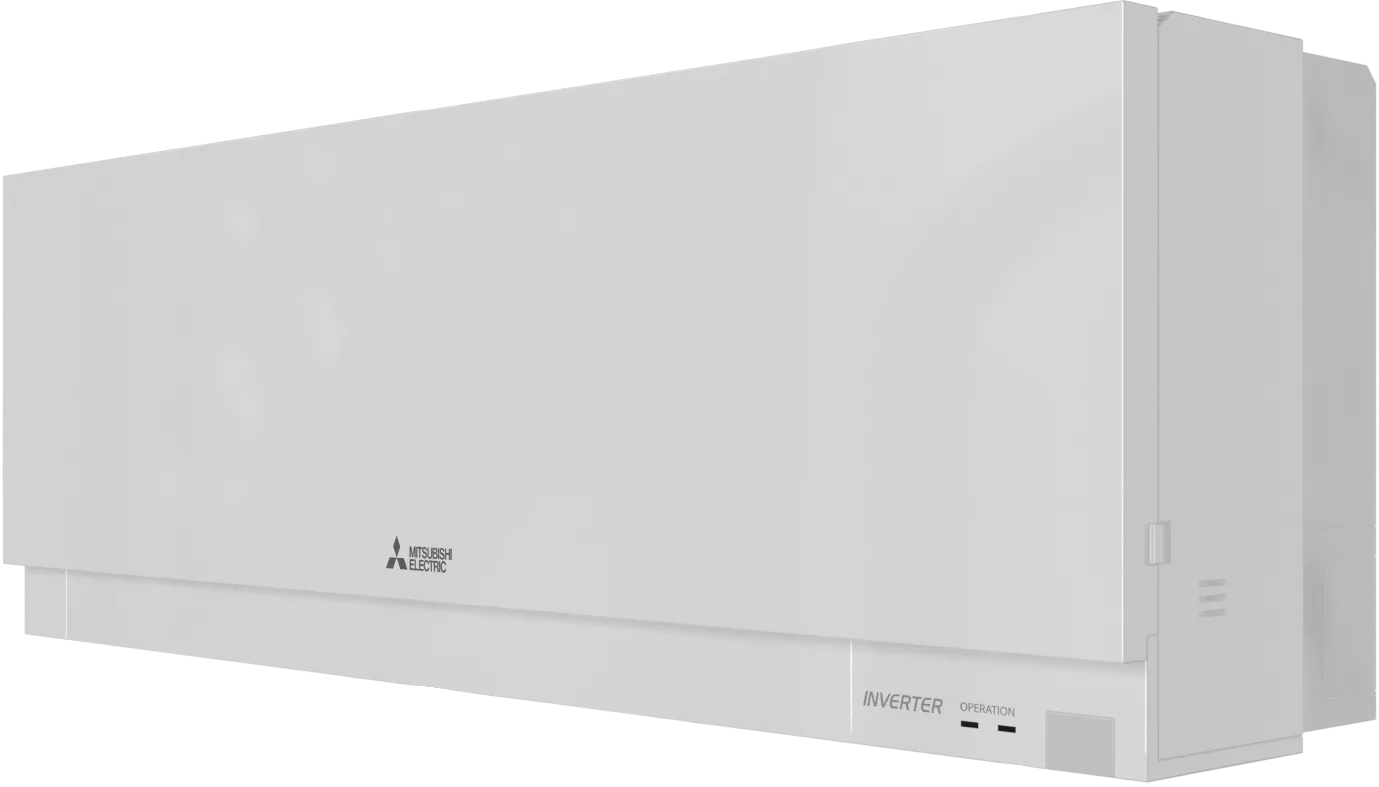
The MSZ-EF indoor unit measures just 299mm high × 885mm wide × 195mm deep, giving it a slim, low-profile appearance on the wall.
More importantly, it’s available in:
- Natural White
- Matte Silver
- Glossy Black
That matters in modern Australian homes. A black or silver indoor unit can complement dark feature walls, joinery or architectural finishes instead of fighting against them.
This isn’t marketing fluff either. The series has received international design recognition, including the Red Dot Design Award, IF Design Award and Good Design Award, positioning it firmly in the “designer split system” category.
2. Quiet Enough for Bedrooms
Noise is one of the most underestimated factors in split system comfort.
The MSZ-EF25 model operates as low as 19dB in quiet mode, while the EF35 operates from 21dB in quiet mode. That’s whisper-level performance, ideal for bedrooms, studies or nurseries where constant fan noise can be disruptive.
Even at higher fan speeds, indoor sound pressure levels remain controlled within expected residential comfort ranges.
3. Smarter Air Quality Control
The MSZ-EF Series comes standard with a Nano Platinum Deodorising Filter, designed to reduce airborne bacteria and improve indoor air quality.
For households wanting deeper filtration, Mitsubishi offers:
- Optional Electrostatic Anti-Allergy Enzyme Filter
- Optional Plasma Quad Connect (MAC-100FT-E), which targets six key indoor pollutants, including influenza virus, bacteria, PM2.5, allergens, mould and dust
Features of the MSZ-EF Series That Upgrade Comfort
The MSZ-EF series air conditioners from Mitsubishi Electric build comfort through features like airflow control, smart scheduling, filtration and usability working together.
Advanced Airflow & Temperature Stability
One of the biggest frustrations with standard split systems is uneven cooling. You feel a cold air blast directly below the unit, while the far corner of the room remains warm.
The MSZ-EF Series uses inverter-driven compressor technology to maintain temperature stability rather than constantly cycling on and off. That matters because:
- Fewer aggressive temperature swings
- Reduced compressor strain
- Lower peak energy spikes
- More consistent comfort across the room
Instead of overcooling and then shutting down, the system modulates output to maintain your set temperature more precisely.
Built-In Weekly Timer
Most households don’t need manual control every single day. They need predictability.
The built-in 7-day programmable weekly timer allows you to schedule temperature settings and on/off cycles in advance. This is particularly useful for:
- Weekday work schedules
- Pre-heating bedrooms before sleep
- Managing energy use during unoccupied hours
Built-In Wi-Fi & Smart Control
The MSZ-EF Series includes built-in Wi-Fi, enabling control via smartphone or tablet through Mitsubishi Electric’s app platform. With internet access, you can:
- Adjust temperature remotely
- Turn the unit on before arriving home
- Monitor usage patterns
- Integrate with Amazon Alexa or Google Assistant (with compatible devices)
This is an important feature for households managing multiple zones or wanting tighter control over energy consumption. Because let’s admit it, convenience is comfort.
Air Quality Beyond Basic Filtration
Comfort isn’t only thermal. It’s respiratory.
The Nano Platinum Filter is designed to reduce airborne bacteria and deodorise air. For families concerned about allergens, the optional Electrostatic Anti-Allergy Enzyme Filter provides additional reduction of common allergens (tested under JIS L1902 standards).
The optional Plasma Quad Connect takes filtration further by targeting:
- Influenza virus
- Bacteria
- PM2.5 particles
- Allergens
- Mould
- Dust
For households in urban environments or with allergy-sensitive members, this elevates the MSZ-EF beyond a simple heating and cooling appliance.
It becomes part of indoor air management.
Mitsubishi Electric MSZ-EF Series Engineering
Until now, we know that the series has great features and design. However, it would mean nothing if the engineering is not at par.
Capacity Range & Application
The MSZ-EF Series is available in the following cooling capacities:
- 2.5kW (EF25)
- 3.5kW (EF35)
- 4.2kW (EF42)
- 5.0kW (EF50)
With heating capacities ranging from 3.2kW to 5.8kW, this makes the series suitable for:
- Bedrooms (2.5kW)
- Medium living rooms (3.5-4.2kW)
- Larger open areas or combined spaces (5.0kW)
Correct sizing remains critical. Oversizing increases upfront cost and reduces efficiency. Undersizing causes constant strain and poor performance.
To know if this is the right air conditioner for you, book a free consultation with EcoOrigin
Energy Efficiency
While exact COP/EER values vary by model and conditions, the use of R32 refrigerant improves system efficiency compared to older R410A-based systems. R32 offers:
- Higher thermal efficiency
- Lower refrigerant charge volume
This results in improved environmental performance and more efficient heat transfer under normal operating conditions.
Acoustic Engineering
Noise specifications across the range are controlled carefully:
- Indoor quiet mode as low as 19dB (EF25)
- Typical indoor range is between 19-43dB, depending on fan speed
- Outdoor units between 47-52dB sound pressure levels
Physical Dimensions & Installation Considerations
All indoor units share a consistent slim profile:
299mm (H) × 885mm (W) × 195mm (D)
Weight: 11.5kg
The compact depth makes it suitable for:
- Feature walls
- Narrow bulkhead installations
- Apartments with limited clearance
Outdoor unit dimensions vary slightly by capacity, with the EF50 model featuring a larger outdoor unit for increased output.
Installation quality remains a major determinant of long-term performance. Even the best-engineered unit will underperform if installed poorly.
Is It Worth It?
What you’re really assessing here is the combination of design integration, acoustic performance, filtration capability and long-term inverter efficiency.
If your home has been thoughtfully designed, darker feature walls, architectural finishes, open-plan living and the availability of Natural White, Matte Silver and Glossy Black genuinely change how the unit integrates visually. For some homeowners, that matters more than an incremental efficiency gain on paper.
Then there’s acoustic performance. Indoor sound levels as low as 19dB (model dependent) are not standard across all split systems. In bedrooms and studies, this becomes noticeable over time. The absence of constant fan noise contributes to comfort in a way that isn’t immediately obvious.
From an engineering perspective, inverter modulation, R32 refrigerant efficiency and Mitsubishi Electric’s established compressor reliability contribute to stable, predictable performance. While no air conditioner eliminates running costs, systems that maintain consistent output rather than aggressively cycling tend to feel smoother in daily use.
That said, value is contextual.
If the goal is purely the lowest upfront cost, there are simpler systems available. If the property is a rental with minimal focus on aesthetics or acoustic refinement, this system may not be the right choice for you.
However, for homeowners who view heating and cooling as a long-term infrastructure decision, something that impacts comfort, interior design and operating efficiency for the next decade, the MSZ-EF Series presents a well-rounded case.
Advantage of VEU Rebate
For Victorian households upgrading from older or inefficient systems, the air conditioner rebate Victoria can significantly reduce upfront installation costs.
This Victorian split system rebate falls under the Victorian Energy Upgrades (VEU) program, which incentivises eligible energy-efficient upgrades with an upfront discount of new air conditioner.
Important clarification:
Not every model automatically qualifies.
Select models may be eligible under VEU depending on:
- The selected model should be VEU-approved
- Replacement of an eligible existing heating system (e.g. gas ducted)
- Installation by an accredited provider
For households replacing gas heating with a qualifying reverse cycle split system, the rebate can make a premium system like the MSZ-EF more financially accessible.
To know if the air conditioner is eligible for a rebate, Contact EcoOrigin.
Claim VEU Rebate with EcoOrigin
Navigating the split system rebate Victoria requirements can be confusing. Documentation, eligibility checks and installation compliance must be handled correctly to secure incentives.
This is where working with an accredited provider matters.
EcoOrigin assists by:
- Assessing whether your existing system qualifies for replacement
- Confirming whether a selected MSZ-EF model is right for your home
- Completing installation in compliance with program requirements
- Processing the necessary rebate documentation
Conclusion
When comparing multi-split systems, most buyers focus on capacity and price. But over time, those are rarely the factors that define satisfaction.
What tends to matter more is how the system performs on the days whe temperature has reached extremes. Does it run quietly enough that you forget it’s on? Does it maintain a stable temperature without constant adjustment? Does it sit on your wall without clashing with the rest of the room? Those small details compound over the years of daily use.
The Mitsubishi Electric MSZ-EF Series is positioned for households that think long-term. It combines refined aesthetics, controlled inverter performance, layered filtration and smart connectivity in a way that feels deliberate rather than feature-heavy.
However, if you want to take advantage of victorian government split system rebate, make sure to select a VEU-approved model. Always reach out to a trusted, accredited provider for guidance related to selecting the right air conditioner. They will also help you fulfil all eligibility requirements so that you can save thousands of dollars through the rebate.
FAQs
1. Is Mitsubishi Electric a good air conditioner brand in Australia?
Yes. Mitsubishi Electric is widely regarded in Australia for reliable inverter technology, quiet operation and consistent performance in both heating and cooling modes. It is commonly chosen for long-term residential installations where durability and acoustic comfort matter.
2. What size split system do I need for my room?
Sizing depends on room size, ceiling height, insulation, window exposure and climate zone. As a rough guide, 2.5kW suits small bedrooms, 3.5-4.2kW suits medium living areas and 5.0kW suits larger open spaces. A proper heat load assessment is more accurate than guessing based on square metres alone.
3. Is it worth replacing gas ducted heating with a reverse cycle multi-split system in Victoria?
For many households, yes. Reverse cycle multi-split systems are often more energy-efficient than older gas ducted systems, especially when paired with solar. Many homeowners explore this option alongside the air conditioner rebate victoria, which can reduce upfront upgrade costs if eligibility criteria are met.
4. What is the Victorian government's split system rebate?
The Victorian government split system rebate refers to the rebate available under the Victorian Energy Upgrades (VEU) program. It supports eligible households upgrading from inefficient heating systems to approved high-efficiency reverse cycle systems installed by accredited providers.
5. How much is the split system rebate Victoria?
Rebate amounts vary depending on factors such as the system being replaced, the efficiency of the new unit and the property type. Under the split system rebate in Victoria, incentives are typically applied as an upfront discount rather than a cashback payment later.
6. Do all split systems qualify for the air conditioner rebate in Victoria?
No. Not every model qualifies automatically. To be eligible under the air conditioner rebate Victoria, the system must be VEU approved and be installed by an accredited provider under the VEU scheme. Replacement of an eligible existing heating system is often required.