
How to Get Your Split System Ready for Summer in Victoria
Major Benefits
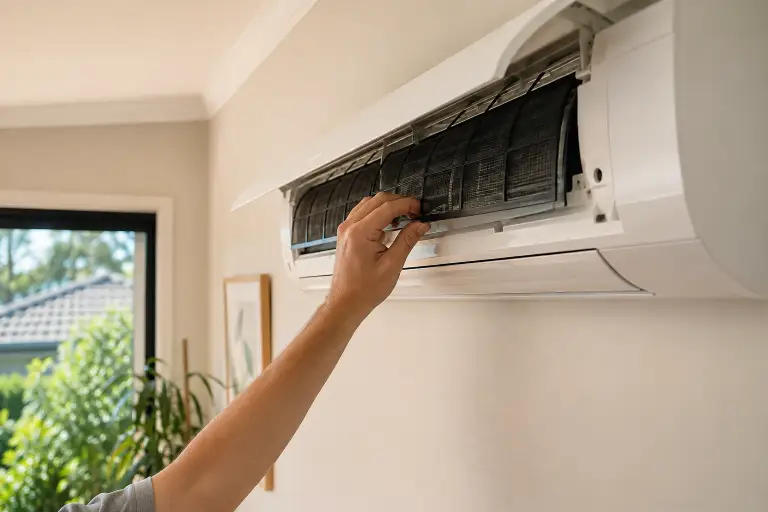
No matter whether your split system's sat idle since last autumn or you've had it running as a heater all winter, don't wait for the first properly hot day to find out whether it still cools properly. A few checks now (most of them five minutes each) can save you a call-out fee and an uncomfortable week in January.
Start with the filters. Clear the outdoor unit. Run the system on cooling and pay attention to how it sounds, smells and performs. If something's off after that or the unit is old and you're not sure it's worth fixing again, this guide covers what to check yourself, what to leave to a professional and where a Victorian Energy Upgrades discount fits in if you end up replacing it.
Table of Contents
- Quick Summary
- Clean Your Filters First
- Check the Indoor Unit
- Clear the Outdoor Unit
- Signs Your Split System Isn't Coping
- Get Your Settings Right
- What You Can Check Yourself vs What Needs a Technician
- Repair or Replace?
- FAQs
- Clean or check the filters - go by your manual, not a guess
- Clear leaves and debris from the outdoor unit so air can actually move
- Run the system on cooling and listen for anything that sounds off
- Leave wiring, refrigerant and internal repairs to a licensed technician
- If it's old or breaking down often, weigh up repair against replacement
- Replacing it may qualify for a discount through Victorian Energy Upgrades (VEU), depending on what you're replacing
A dirty filter is the number one reason a split system stops cooling the way it should. Airflow drops, the unit works harder than it needs to and your power bill quietly climbs.
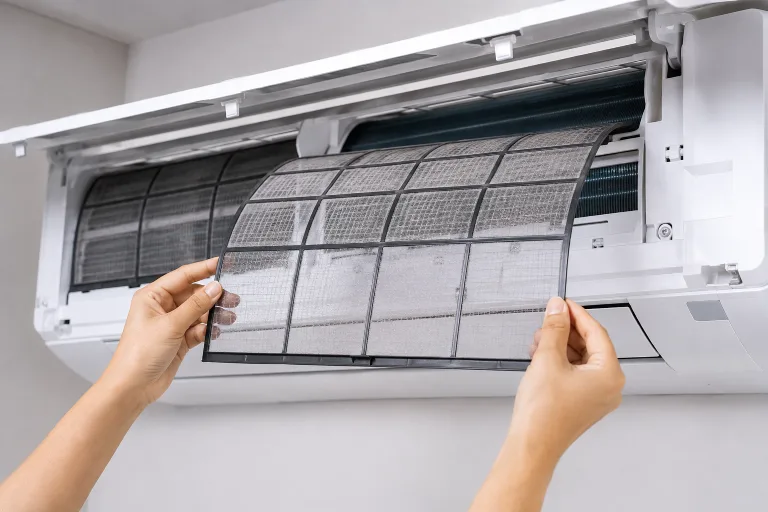
Most indoor units let you slide the filter out by hand. Vacuum off the loose dust or rinse it if your manual says that's fine, then let it dry properly before putting it back in. There's no single cleaning interval that works for every household. It depends on how much the system runs and how much dust and pet hair is floating around your place, so check the manual instead of guessing.
While the filter's out, look over the rest of the unit. Dust on the vents is normal enough. A musty smell when the fan starts, staining near the unit or water dripping where it shouldn't, is not normal. A wipe-down of the visible casing is fine to do yourself. Mould inside the unit or water you can't explain is a job for a technician, not a rag.
The outdoor unit needs airflow to work properly and it's usually the part people forget about. Leaves and grass clippings pile up over autumn and winter without anyone noticing. Clear the area around it, cut back anything growing too close and make sure nothing's sitting against the fan or vents.
Don't open the casing. Whatever's inside is electrical or refrigerant and neither is a weekend project.
Once the filter's clean and the outdoor unit's clear, run the system for a while and pay attention to:
- Airflow that's weak even with a clean filter
- Cooling that never quite reaches your set temperature
- Rattling, buzzing or grinding
- A smell that doesn't go away after cleaning
- Water leaking anywhere
- The unit cycling on and off more than it used to
- A long delay before cool air actually comes through
One of these after months of not running the system might be nothing. Several at once or anything that sticks around, means it's time to get someone to look at it.
Double-check that the unit is actually set to cooling, not fan or heating. It sounds obvious, but it's an easy one to miss if you've had it on heating mode all winter - or haven't touched the remote in months.
There’s no single “correct” temperature for every home, but around 24°C is generally a comfortable and practical starting point for ducted air conditioning during summer. The bigger the gap between the outdoor temperature and your indoor setting, the harder your system has to work, which can increase energy use and running costs.
If your system has a timer or scheduling function, use it to avoid running the air conditioner when nobody is home. It’s one of the simplest ways to keep summer energy bills under control.
Cleaning the filter, clearing the outdoor unit, wiping down what you can see and checking your remote settings are all fine to do yourself. Opening electrical panels, touching wiring or getting anywhere near refrigerant isn't.
Call a professional if:
- Cooling stays poor even after a proper clean
- A noise doesn't go away
- A smell hangs around after cleaning
- The unit is leaking water
- The same fault keeps coming back
- It just hasn't run right for a while and you've done everything above
How often a split system needs a proper service depends on the model and how hard it's used. Follow what the manufacturer recommends rather than waiting until it stops working altogether.
If the system just needs a clean, you're probably done. If it's old, keeps breaking down or is clearly struggling, replacement is a real option, not just a way to avoid another repair bill.
A few things worth weighing up: how old it is and how it's been running lately, how often it's broken down, what another repair would cost against a new system, how much less efficient it is than a current model, whether parts are even still available and whether it still does what your household actually needs it to do.
There's no age at which a split system automatically needs replacing. It comes down to the condition of the unit in front of you and whether another repair genuinely makes financial sense. If replacement is where you land, that's where a Victorian government split system rebate becomes relevant.
People searching for a Victorian government split system rebate or a Victorian energy rebate are usually after the same thing: help with the cost of a new air conditioner from the state government.
In Victoria, that comes through Victorian Energy Upgrades (VEU), a program rather than a separate scheme with either of those names.
An approved, high-efficiency reverse cycle air conditioner installed by an accredited provider can attract a discount. Most split systems fall under non-ducted reverse cycle air conditioners, which are covered and there's no minimum system size to qualify. The product needs to be on the approved list, come with at least a 5-year warranty on home installs and if you're replacing an existing system, that system generally needs to be more than 2 years old.
Not every system qualifies automatically and how much you get depends on what's being replaced. Swap an old gas heater for a reverse cycle system and the discount is significant. Swap one reverse cycle split system for a newer one and it's a lot smaller, since there's less of an efficiency jump to work with, so it's worth confirming the actual number before you get your hopes up.
Only accredited providers can apply the discount and it shows up as a reduction on your quote rather than money back after the fact. If you've already got an installer in mind, they can work with an accredited provider to apply it, as long as that's arranged before any work starts.
A note on the 30 September 2026 changes
The Victorian Government has confirmed changes to VEU heating and cooling from 30 September 2026.
So, from 30th September’2026, the minimum co-payment rises to $3,000 for ducted systems and for multi-split systems of 10kW or more. Multi-split systems under 10kW stay at the current $1,000 minimum and a 20kW cap applies to how much capacity counts toward the incentive on residential multi-split installations.
If you're looking at a single-room split system rather than a multi-split or ducted setup, this change doesn't really affect you, but it's still worth checking with your provider how the current rules apply to your specific upgrade.
You might also like: 10 Things You Should Know About Aircon Rebate Victoria 2026
If you're still on a gas-ducted system, switching to a split system is worth a proper look. It's usually cheaper to run and, depending on what you're replacing, it can qualify for a meaningful VEU discount. EcoOrigin takes care of the installation and makes sure you get the maximum saving on offer. Reach out before summer hits and let EcoOrigin walk you through it.
How do I prepare my split system for summer?
Clean the filter, clear the outdoor unit and run it on cooling for a while to see how it performs before the weather turns.
How often should I clean my split-system filter?
There's no fixed answer. Check your manual and clean it more often if airflow drops or dust starts building up.
Why is my split system not cooling properly?
Usually a dirty filter or a blocked outdoor unit. Clean both first. If it's still not cooling, get a technician to look at it.
Should I service my split system before summer?
If poor airflow, smells or noises are still there after a clean, book a service before summer rather than waiting for it to fail during a heatwave.
When should I replace my split air conditioner?
When repairs are getting frequent or expensive, it's clearly inefficient or it's just not keeping up with what your household needs.
Can I get a Victorian government split system rebate when replacing an old system?
Possibly. VEU discounts apply to approved reverse cycle systems installed by an accredited provider and the amount depends on what you're replacing.
Does every split system qualify for a Victorian Energy Upgrades discount?
No. The product has to be on the approved list and meet program requirements, including the warranty rules. Check with an accredited provider first.
Do I need an accredited provider and can I choose my own installer?
Only an accredited provider can apply the VEU discount. You can still use your own installer if they arrange it with an accredited provider before the job starts