
What Does Reverse Cycle Mean? A Simple Guide
Major Benefits
If you’ve been researching heating and cooling systems lately, chances are you’ve seen the term “reverse cycle air conditioning” everywhere.
But for many homeowners in Victoria, the term still feels confusing.
Is it the same as a split system?
Does it actually heat your home properly during winter?
Is reverse cycle cheaper than gas heating?
And why are so many Australians suddenly switching to it?
These are exactly the kinds of questions people ask before upgrading their home heating and cooling system. Especially now, when energy prices continue to rise and more households are looking for efficient electric alternatives.
The good news is that reverse cycle air conditioning is much simpler to understand than it sounds.If you’re a first-time buyer trying to understand whether reverse cycle air conditioning is right for your home, this guide will help you make a confident decision.
Here’s what we will explain in this blog :
- What Does "Reverse Cycle" Actually Mean?
- How Does Reverse Cycle Air Conditioning Actually Work?
- Is a Reverse Cycle Air Conditioner the Same as a Split System?
- Types of Reverse Cycle Systems & Which One Suits Your Home?
- Top 5 Reverse Cycle Air Conditioner Brands in Australia
- Government Rebates When You Switch to an Energy-Efficient Reverse Cycle System
- Conclusion
A reverse cycle air conditioner is a system that can both cool your home in summer and heat it in winter using a single unit. The "reverse cycle" part refers to the way it achieves this: by reversing the direction of its refrigeration cycle depending on what you need.
In summer, it pulls heat out of the air inside your home and dumps it outside. In winter, it reverses the process, it extracts heat energy from the outdoor air (even when it feels cold outside) and transfers it into your home.
This might sound counterintuitive. How can a machine extract heat from cold outdoor air? The answer lies in thermodynamics: even at 5°C or 2°C, outdoor air still contains usable heat energy. A reverse cycle system uses a refrigerant, a special fluid that changes between liquid and gas states at very low temperatures to capture that energy and concentrate it indoors.
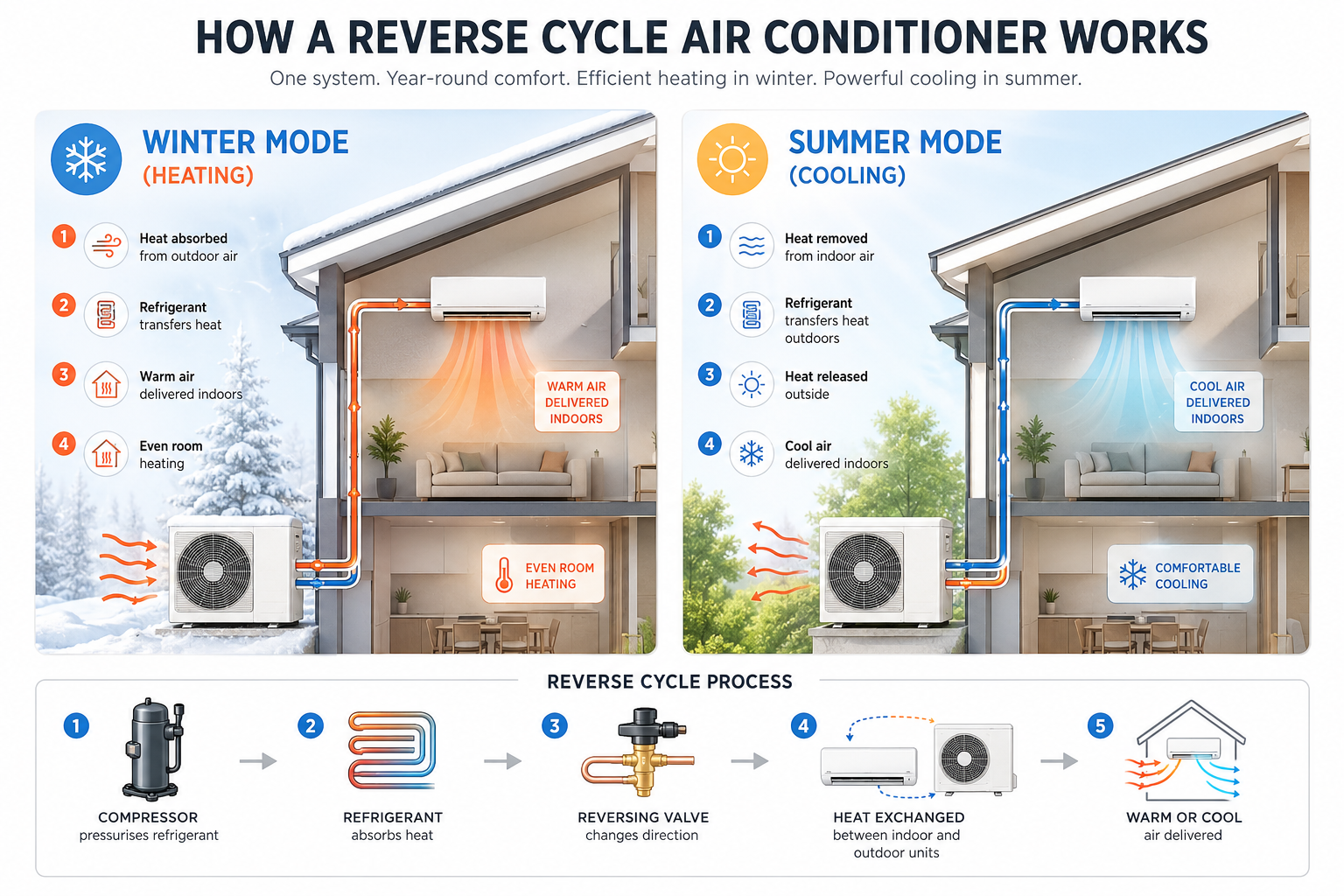
Every reverse cycle air conditioner has four main components: a compressor, a condenser, an evaporator and an expansion valve. Together, they form a closed loop through which refrigerant continuously circulates.
In cooling mode, the cycle works like this. The refrigerant arrives at the indoor evaporator coil in a cold, low-pressure liquid state. As warm indoor air blows over the coil, the refrigerant absorbs the heat and evaporates into a gas. That gas travels outside to the compressor, which pressurises it, raising its temperature further. It then flows into the outdoor condenser coil, where it releases its heat into the outside air and condenses back into a liquid. The expansion valve then reduces its pressure again, cooling it rapidly before it returns indoors and the cycle repeats.
In heating mode, the system simply reverses the direction of refrigerant flow. Now the outdoor coil acts as the evaporator, absorbing heat from the outside air even on a cold day. The refrigerant carries that heat energy inside, where it is released via the indoor coil, warming your room. The outdoor unit expels cold air in this mode, which is why you might notice cool air blowing from the external unit on a winter's day.
This is one of the most searched questions on the topic and it causes genuine confusion because the two terms are often used interchangeably. They are not the same thing but they are very closely related.
Here is the clearest way to think about it:
A split system air conditioner consists of two separate components: an indoor unit (typically wall-mounted) and an outdoor unit (which houses the compressor and condenser). The two units are connected by refrigerant pipes and electrical cables running through the wall. This "split" design keeps the noisy mechanical components outside, which is why split systems are so quiet indoors.
Reverse cycle describes what the system can do. It is a function, the ability to provide both heating and cooling by reversing the refrigerant cycle.
The relationship between the two is this: a split system can be either cooling-only or reverse cycle. A reverse cycle system can take the physical form of a split system, a multi-head system or a ducted system.
In practice, however, nearly every split system sold in Australia today is a reverse cycle model. Cooling-only split systems still exist, but they represent a tiny fraction of the market and for good reason. Paying for a system that can only cool when you could have one that heats and cools for a similar price makes very little sense, particularly in Victoria, where winters are genuinely cold.
So, "Is a reverse cycle air conditioner the same as a split system?", the honest answer is: most of the time, yes, because most split systems are reverse cycle. But technically, they describe different things. The split system is the body; the reverse cycle is what's under the bonnet.
A Quick Comparison
Reverse cycle technology comes in several physical configurations. Choosing the right one depends on your home's size, layout, budget and whether you're renting or own your property.
Single Split System
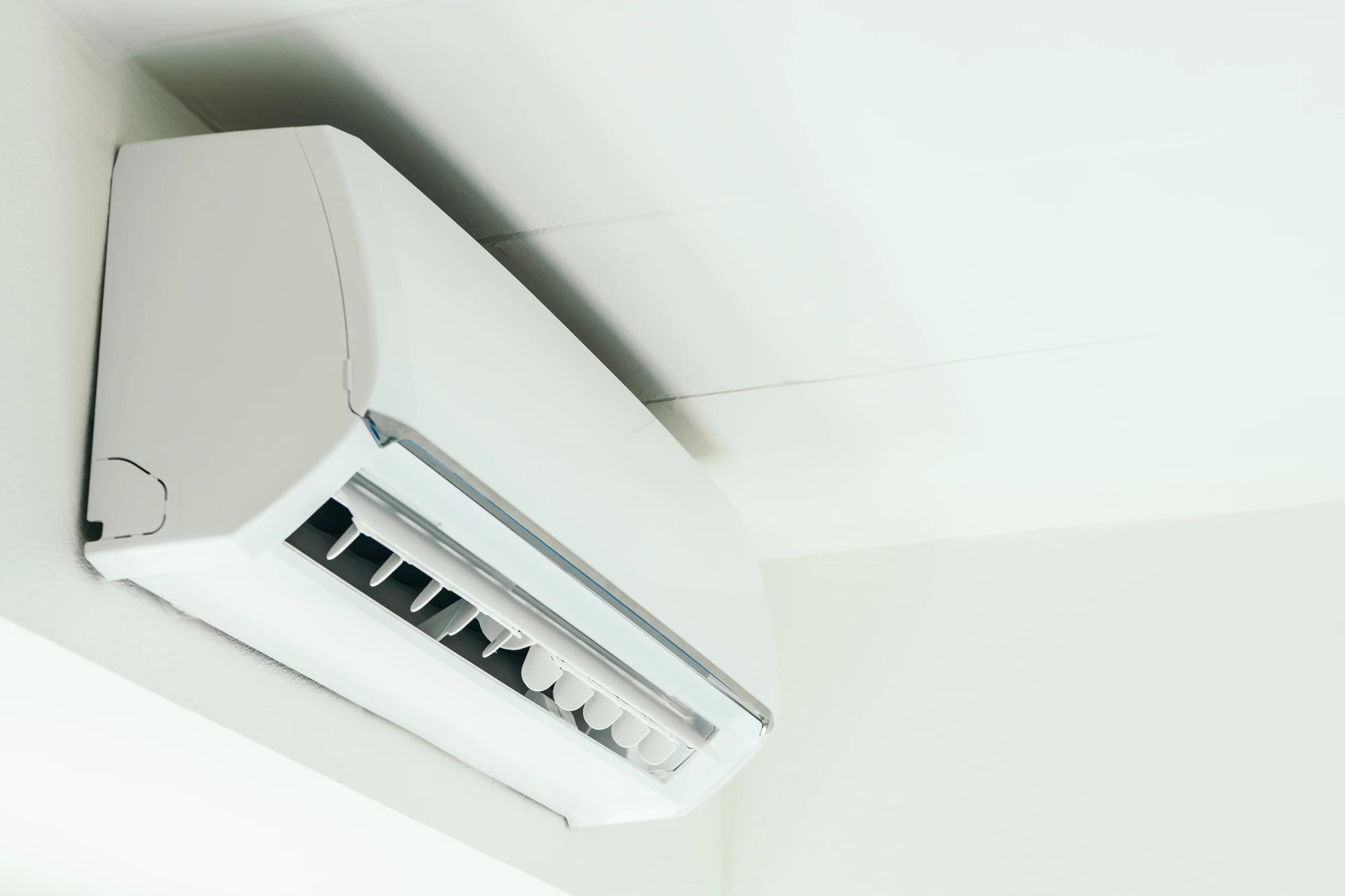
This is the most common reverse cycle setup in Australian homes. One indoor unit is mounted on a wall in a single room or zone, connected to one outdoor unit. It is ideal for heating and cooling a bedroom, living room or open-plan kitchen-dining area.
Single split systems are the most affordable option to purchase and install and they are highly energy-efficient because you are only conditioning the space you are using. A 2.5kW unit suits a small room of around 20–30m²; a 5kW unit is suitable for a medium-large living area; and a 7-9kW model handles large open-plan spaces.
Best for: Apartments, rental properties, homeowners targeting one or two key rooms, first-time buyers on a tighter budget.
Multi-Head (Multi-Split) System
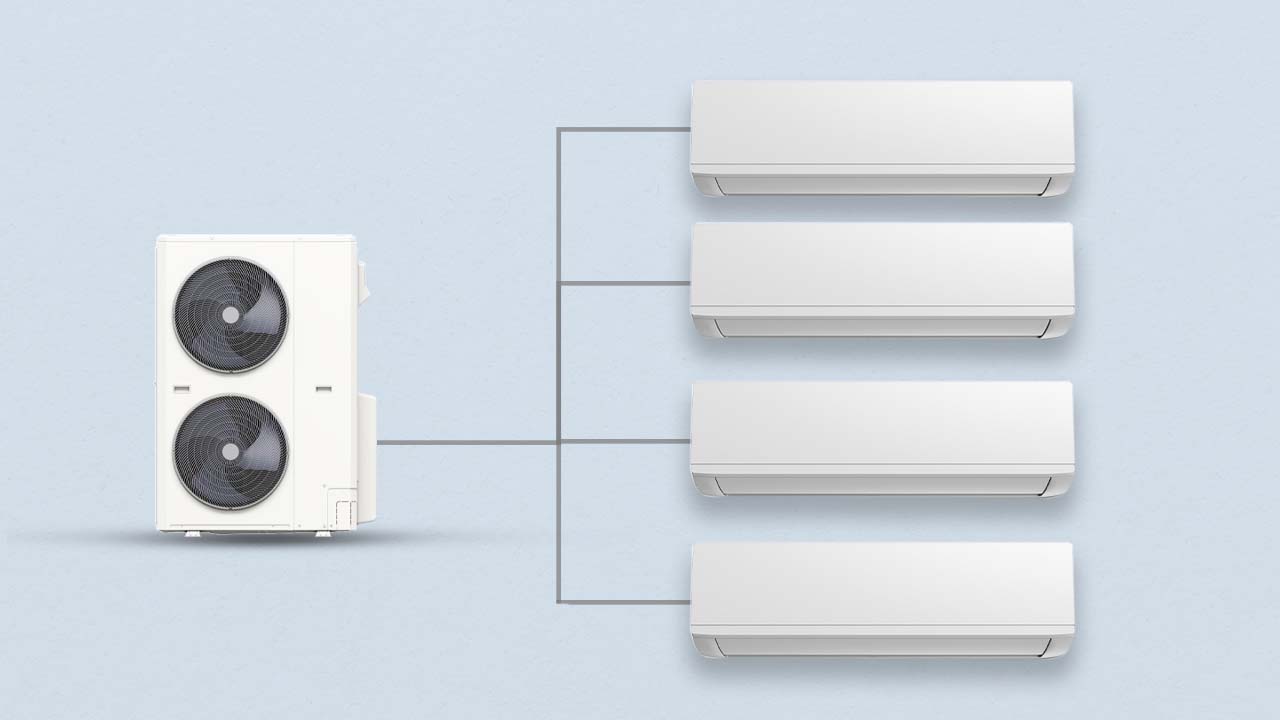
A multi-head system connects multiple indoor units, typically two to five, to a single outdoor unit. Each indoor unit can be controlled independently, allowing different rooms to be set to different temperatures simultaneously. This setup avoids cluttering the exterior of your home with multiple outdoor units.
Multi-head systems are more efficient than running several separate systems because the shared outdoor unit is larger and more powerful. The trade-off is a higher upfront cost compared to a single split and if the outdoor unit requires servicing, all zones are affected at the same time.
Best for: Homeowners wanting whole-home comfort without ducted installation, properties where running multiple outdoor units is not practical and families with different temperature preferences in different rooms.
Ducted Reverse Cycle System
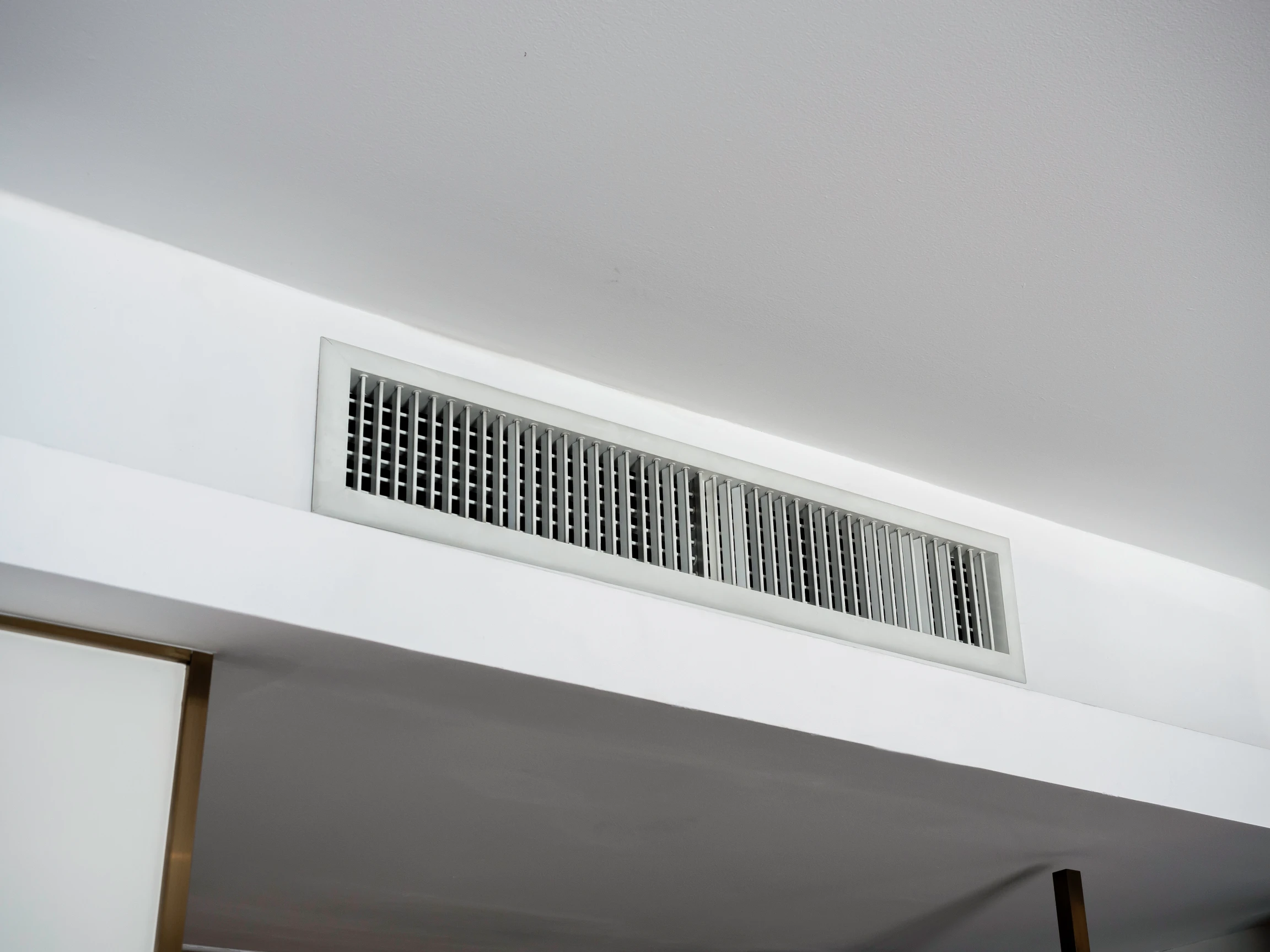
A ducted reverse-cycle system is the whole-home solution. A central indoor unit, usually installed in the roof space, distributes conditioned air through a network of ducts and ceiling vents throughout the house. Because it is concealed, there are no visible wall units, making it a popular choice for new builds and higher-end renovations.
Modern ducted reverse cycle systems include zone control, which means you can choose to heat or cool only the rooms that are occupied at any given time. This reduces running costs significantly compared to heating or cooling the entire house at once. Ducted systems are the most expensive option to install but for a whole-home solution, they offer unmatched comfort. Additionally, when you are replacing an old gas ducted heater, you are eligible for one of the largest rebates available under Victoria's energy upgrade program.
Best for: Whole-home comfort in larger homes (150m² and above), homeowners replacing ducted gas heating, new builds and anyone prioritising aesthetics and a clean finish.
Australia has several trusted air conditioning brands, but a few consistently stand out for performance, efficiency and reliability.
Here are some of the most recognised reverse cycle brands homeowners often consider.
Mitsubishi Electric
Mitsubishi Electric is widely recognised for:
- strong energy efficiency
- reliable heating performance
- quiet operation
- premium build quality
The brand is especially popular among homeowners looking for long-term reliability and efficient winter heating.
Rinnai
Rinnai has a strong presence in Australian heating and cooling.
Their reverse cycle systems are often considered by homeowners looking for:
- practical functionality
- reliable performance
- and systems suited for Australian conditions
The brand is also well known in the heating industry, which gives many homeowners added confidence during upgrades.
Midea
Midea has become increasingly visible in Australia due to its competitive pricing and improving technology features.
Many homeowners consider Midea systems when looking for:
- affordable reverse cycle options
- inverter technology
- and modern smart features at lower price points
AUX Air Conditioner
AUX is another growing brand in the Australian air conditioning market.
The brand has gained attention for offering:
- energy-efficient systems
- modern designs
- and competitive pricing
AUX has also partnered with Panasonic in certain markets and manufacturing collaborations, which has increased awareness around the brand globally.
Panasonic
Panasonic remains one of the most recognised names in home appliances and air conditioning.
Their reverse cycle systems are often chosen for:
- energy efficiency
- air purification technology
- smart control features
- and strong overall performance
Important: These brands are not ranked in any particular order. The selection is based on factors such as affordability, popularity in Australian homes, energy efficiency features and suitability for different upgrade and rebate scenarios.
Also Read: Top 10 Air Conditioners In Australia: A Comprehensive Guide
Here is something a surprising number of Victorian homeowners do not know: you may be able to access a significant upfront discount, potentially thousands of dollars, when you replace your current heating or cooling system with an eligible energy-efficient reverse cycle air conditioner.
The Victorian Energy Upgrades (VEU) Program
The Victorian Energy Upgrades (VEU) program is a Victorian Government initiative administered by the Essential Services Commission (ESC). Its purpose is to reduce household and business energy consumption, lower greenhouse gas emissions and help Victorians cut their energy bills by making energy-efficient upgrades more affordable.
Under the Victorian energy rebate, you get an upfront discount when switching to a reverse-cycle air conditioner. This way, you don’t have to wait for months to claim it.
Who Is Eligible?
- Your property must be located in Victoria
- The property (and the system being replaced, if applicable) must be at least two years old
- You must not have claimed a VEU heating or cooling upgrade on the same property within the last two years
- The new system must be an eligible reverse cycle air conditioner listed on the VEU Register of Products maintained by the ESC
- Installation must be done under the supervision of accredited provider
How to Apply for Air Conditioner Rebate Victoria?
All you have to do is reach out to a government-accredited provider like EcoOrigin. An accredited provider shares eligible products and recommends the right system for your home. Then, you need to schedule installation and receive your upfront discount. All the necessary compliance requirements are managed by an accredited provider. The system is designed to make the switch simple for Victorian homeowners.
A reverse-cycle air conditioner is the most energy-efficient, versatile and cost-effective way to heat and cool a Victorian home in 2026. It does in one system what previously required two and it does it at a fraction of the running cost of gas heating or electric resistance heaters.
For Victorian homeowners who are still relying on a ducted gas heater to get through winter, the case for switching has never been stronger. Gas prices have risen sharply, reverse cycle technology has never been better and the Victorian Government is actively subsidising the transition through the Victorian Air Conditioner Rebate.
1. Does reverse cycle work in winter?
Yes. Reverse cycle systems are designed to heat homes efficiently during Australian winters, including Melbourne conditions.
2. What is the meaning of reverse cycle?
Reverse cycle means an air conditioner can both cool and heat your home by reversing the refrigeration process.
3. Is reverse cycle cheap to run?
Modern reverse cycle systems are generally energy efficient and can be cheaper to run than many older electric or gas heating systems.
4. How do you use reverse cycle air conditioning?
Simply switch the system between cooling mode and heating mode using the remote or controller, then set your preferred temperature.
5. Are reverse cycle systems energy efficient?
Yes. Reverse cycle air conditioners are considered one of the most energy-efficient heating and cooling options for homes.